
4 hr
Bahrain Desert & Heritage Half-Day Tour
Discover Bahrain's top landmarks in 4 hours: F1 circuit, ancient burial mounds, Tree of Life, and more
Reserve
Hand-picked by our editors — only the best 5 tours from 37 reviewed.
Verified partners for every tour, free cancellation where available, and instant confirmation on every booking.
4 hr
Discover Bahrain's top landmarks in 4 hours: F1 circuit, ancient burial mounds, Tree of Life, and more
Reserve
5 hr
Five-hour journey through Bahrain's heritage sites, markets, mosques, and camel encounters with transfers
Reserve
6 hr
Journey through Bahrain's iconic landmarks from ancient forts to modern racing circuits in one comprehensive day
ReservePrices from verified partners. Availability updates in real time at checkout. Free cancellation policies apply where shown.
The landmarks, rooms, and views travelers on this tour remember — all visible on a single visit.
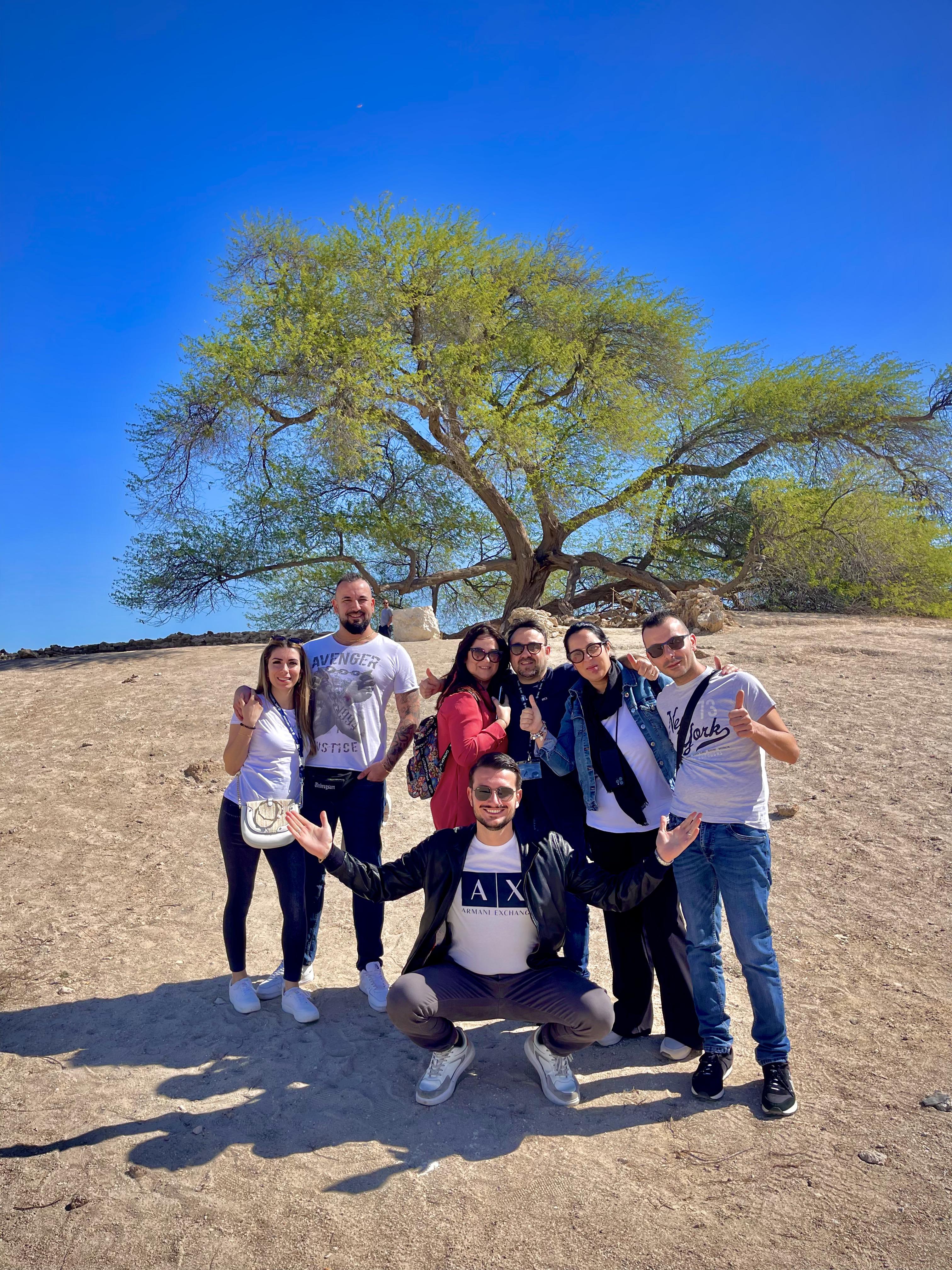
This 400-year-old tree is the centerpiece of any bahrain half day desert tour, surviving in the desert despite the lack of visible water sources.
The highest point in Bahrain provides a dramatic backdrop for a bahrain half day desert tour, perfect for landscape photography.
Often included on a bahrain half day desert tour, this site commemorates the discovery that transformed the nation.
These tours complement each other; most visitors who do both find the shorter desert excursion more focused, while the full-day circuit offers a broader cultural immersion. Whether you need bahrain half day desert tour tickets for a quick outing or a comprehensive landmark journey, your choice depends on your available time in Manama.
| Feature | Top pick Half-Day Desert Tour | Full-Day Island Discovery |
|---|---|---|
Focus |
Desert landscape and geology | |
Primary Locations |
Tree of Life, Jebel Dukhan | |
Typical Duration |
4 hours | |
Pace |
Relaxed and steady | |
Traveler Suitability |
Nature enthusiasts and photographers | |
Accessibility |
Off-road terrain and sand | |
| See tickets → |
Verdict: Select the bahrain half day desert tour for an efficient geological exploration, or choose the full-day Bahrain island landmarks tour if you prefer a wider itinerary including urban sights and historical heritage sites.
Choose your ticket, select your date, and reserve in under two minutes. Secure checkout handled by our verified partner.
Instant confirmation by email, with a mobile voucher you can save offline. No printing, no queuing at a collection desk.
Arrive at the entrance, show your voucher on your phone, and walk in. Most tickets include priority or skip-the-line access.
Practical details for your visit straight from our verified partners — hours, access, rules, and how to get there.
Manama Hotels
Most tour operators include door-to-door pickup.
Follow signs toward Sakhir and Jebel Dukhan; rental cars offer the most flexibility.
Dress modestly to respect local customs, covering shoulders and knees. Opt for lightweight, loose-fitting clothing to handle desert heat and closed-toe shoes to protect your feet from sand.
There are no formal security checkpoints or bag storage facilities at the Tree of Life. Keep your belongings secure in your vehicle or carry a small backpack for essentials.
Photography is encouraged at this desert landmark. The early morning or late afternoon light provides the best conditions for capturing the tree against the barren landscape.
The site consists of open desert terrain with sandy, uneven ground. It is not paved, which may pose challenges for visitors with limited mobility.
Families are welcome, but be aware of the remote desert location. There are no playgrounds or specialized children's facilities on-site.
There are no restaurants or amenities at the site. Carry plenty of water and snacks if you plan a bahrain half day desert tour.
Best time to go, insider tips, nearby landmarks, and the cancellation fine print — flip through to skim what matters to you.
How crowds, weather, and events shift across the year.
November to March offers the most temperate weather for desert excursions.
Expect extreme heat; visit only during the early morning hours.
Ideal for photography as desert landscapes remain relatively mild.
Small details that turn a good visit into a great one.
Arrive between 06:00–10:00 to avoid the most intense sun and tour crowds.
Non-bookable sights within a short walk — free to visit, easy to pair.
The highest point in Bahrain, offering panoramic desert views.
Flexible, no hidden fees.
Full refunds are typically available for pre-booked tour packages if cancelled within the operator's specified window. Note that the Tree of Life entrance fee is 0 BHD, so tour costs cover logistics and guiding services only.
Hand-picked options within walking distance — pick a district for vibe, or a specific hotel for convenience.
Primary hub for all hotel tiers and tourist services.
The Tree of Life stands alone in the Sakhir sand, thirty-two feet of Prosopis cineraria sustained by roots that stretch deeper than any borehole has measured. No surface water exists within two kilometers; no aquifer has been mapped beneath it. Scientists propose capillary action from fossil moisture, yet the mesquite relative has flowered every spring for an estimated four centuries, its canopy shading the coordinates 25.9940° N, 50.5832° E without explanation. Bahrain's most visited natural landmark draws a quarter-million visitors annually, most arriving between October and March when daytime temperatures permit extended photography beneath its branches. The tree occupies the western edge of Bahrain Island, twenty-eight kilometers south of Manama's diplomatic quarter, where the limestone plateau begins its descent toward the Saudi causeway. Jebel Dukhan rises to the south—Bahrain's highest elevation at 134 meters, a geological anticline that trapped the oil discovered in 1932 by Standard Oil of California. The derricks are gone; the drilling museum remains, preserving the Bahrain Petroleum Company archives in a climate-controlled hall beside the original Well Number One. Desert safari routes link the museum, the tree, and the Al Areen Wildlife Park perimeter, threading through gravel plains where Arabian oryx were reintroduced in 1979 after regional extinction. Bahrain half day desert tour departures concentrate between six and ten in the morning, when surface temperatures remain below thirty-two degrees Celsius and the rising sun casts long shadows across the dunes. Tour operators based in Manama combine the tree with either Dilmun burial mounds—331,000 graves mapped by UNESCO across the northern governorates—or the Qal'at al-Bahrain fortress, whose seven archaeological strata span 4,300 years of continuous habitation. Half-day itineraries return passengers to the capital by early afternoon, preserving evenings for the Manama Souq or the Bahrain National Museum's Dilmun Hall. Full-day extensions add the Bahrain International Circuit, where the Formula One pit lane remains open for guided walks on non-race weekends, and the Al-Fatih Mosque, which accommodates seven thousand worshippers beneath a fiberglass dome weighing forty-five tons.
"No surface water exists within two kilometers; no aquifer has been mapped beneath it."
A step-by-step walkthrough of the visit — what you'll see, how long each stage takes, and the details that matter.
You leave Manama before the morning call to prayer, crossing the causeway interchange where the highway splits toward Sakhir. Your driver steers past the Bahrain International Circuit grandstands—empty except for the maintenance crews hosing down the pit straight—and enters the gravel track marked by GPS waypoints rather than painted lines. Thirty minutes from the hotel, the Tree of Life appears as a dark smudge against pale sand, its canopy resolving into individual branches as you approach the chain-link perimeter. You walk the circumference first, counting the carved initials and Instagrammers framing the sunrise through the eastern boughs. The morning light renders the trunk in sepia; you crouch to photograph the root collar, where exposed bark reveals growth rings too dense to count without magnification. Your guide points southeast toward Jebel Dukhan's ridgeline, explaining the aquifer theory while you drain your first water bottle. The temperature gauge in the tour van reads twenty-eight degrees; by noon, it will exceed forty. You return to the vehicle and continue west, stopping at the oil museum's outdoor exhibit—a 1930s drilling rig reassembled beside interpretive panels detailing the first commercial strike. The final stop places you at the Dilmun burial mounds, where low earthworks stretch in rows toward the Saudi border, each concealing a limestone chamber sealed three millennia ago.
No, the entrance fee is 0 BHD as the site is a public landmark.
The Tree of Life is open daily from 06:00–22:00.
Wear modest, loose-fitting clothing that covers your shoulders and knees to stay comfortable in the desert heat.
Yes, you can visit independently, though a bahrain half day desert tour tour can provide valuable historical context.
Yes, a bahrain half day desert tour is generally family-friendly, provided you bring plenty of water and sun protection.
Most visitors reach the Tree of Life by car or by joining a professional bahrain half day desert tour provider.
No, there are no permanent facilities or restrooms at the Tree of Life site.
The best time is between 06:00–10:00 to ensure your bahrain half day desert tour avoids the peak mid-day heat.